


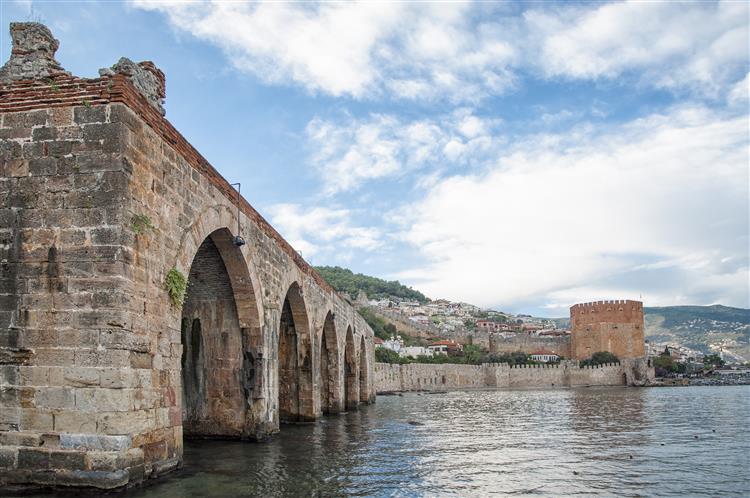
Forget everything you think you know about Mediterranean ports. Beyond the sun-drenched beaches and bustling promenades of modern Alanya lies a portal to a more formidable, maritime age. Tucked beneath the formidable shadow of Alanya Castle, the Alanya Shipyard (Tersane) isn't just another historical site; it's a 13th-century stroke of strategic genius, a perfectly preserved workshop of empire that whispers tales of sultans, naval ambition, and engineering prowess. As a guide who has walked its stone vaults countless times, I invite you to step away from the sun lounger and into the cool, dim light of a dockyard that once aimed to command the sea.
Gateway to the Sultan's Sea: A Strategic Masterpiece
Built in 1228 under the direct order of Sultan Alaeddin Keykubad I, the Alanya Shipyard was far more than a practical dock. It was a bold statement. The Sultan, who proudly bore the title "Sultan of the Land and the Two Seas" (the Mediterranean and the Black Sea), needed a naval base to secure his southern coast and project Seljuk power across the waves. The location was chosen with military precision: protected by the sheer cliffs of the castle above, facing the open sea for quick deployment, and hidden from direct view, making it a secure production site for the galleys that would become the backbone of his fleet.

Approaching from the old northwestern harbor, the first thing that strikes you is its modest, almost secretive entrance. A narrow, rounded-arch gate, just wide enough to accommodate the hull of a ship, belies the vast space within. Above this gate, your eye is drawn to the magnificent five-line inscription in elegant relief script. This isn't just decoration; it's the founding charter. It glorifies Alaeddin Keykubad I and, most importantly, bears the Sultan's personal tughra (imperial seal) flanked by two rosettes—a clear mark of royal ownership and ambition. You are entering the Sultan's personal workshop.
Decoding the Stone: Architecture of Light and Labor
Stepping inside is a revelation. The dim, cool air and the sound of lapping water create an atmosphere that feels centuries removed from the modern town outside. The shipyard is a marvel of pragmatic medieval engineering. It stretches 57 meters deep into the rock and is 40 meters wide, consisting of five long, parallel vaulted docks (or "eyes").
Each dock, varying in length from 32 to 43 meters, is separated by pointed-arch stone walls. The builders used cut stone for the walls but switched to lighter brick for the arches and vaults—a clever technique to manage weight and stress. Look up at the vaulted ceilings: you'll see strategically placed vents. These ingenious openings served a dual purpose: they let in narrow shafts of daylight to illuminate the meticulous work of shipwrights and caulkers, while also funneling out the smoke from forges and pitch fires, creating a surprisingly workable environment.
The floor reveals another adaptation. The docks don't extend fully into the sea; the landward sides are a mix of pebbled shore and solid bedrock. This natural slope allowed for easier launching and careening (tilting ships for hull maintenance). In the third dock, keep an eye out for a freshwater well, a vital resource for the workers and for ships preparing for long voyages.

Secrets in the Stone: The Mosque and the Zulfiqar Frescoes
Flanking the main entrance are two key rooms. On the right, a protruding space was the shipyard's mosque, a place for workers and sailors to pray. On the left, a room with five windows served as the administrative office. But the mosque holds a stunning secret. During recent conservation work, restorers uncovered facing frescoes on two walls depicting the Zulfiqar—the legendary double-bladed sword of Imam Ali, son-in-law of the Prophet Muhammad.
This discovery is profound. The Zulfiqar is a powerful symbol of faith, justice, and divine victory in Islamic tradition. Its presence here, in a functional naval workshop, speaks volumes. It was likely intended to bless the ships built within, to imbue the Seljuk fleet with spiritual protection and moral authority as they sailed forth. It transforms the space from a mere factory into a sanctified ground of imperial and religious mission.
The Living Context: Alanya's Defensive Triad
The shipyard cannot be understood in isolation. It was one part of a formidable defensive triad conceived by Sultan Alaeddin Keykubad I, designed to make Alanya an impregnable naval fortress.
Alanya Castle (Alanya Kalesi)
The shipyard's mighty protector. This 6.5km-walled citadel crowns the entire peninsula. A climb (or cable car ride) to its summit rewards you with breathtaking views and a tangible sense of the castle's strategic dominance. Its walls, towers, and secret passages housed garrisons, civilians, and provided a bird's-eye view of the sea for miles. Any threat to the shipyard below would be spotted immediately from this eagle's nest.

The Red Tower (Kızılkule)
Guarding the very harbor that leads to the shipyard is this iconic, five-story octagonal tower. Built from distinctive red brick, its purpose was unequivocal: to protect the harbor and the shipyard's entrance. Its ground floor now houses the Alanya Ethnographic Museum, but in the 13th century, it was a bustling point of control, where goods and security were monitored. Standing between it and the shipyard, you can feel the layered defense.
Alanya Harbor & Boat Tours
Today's vibrant harbor is the direct descendant of the Seljuk port. While modern yachts and gulets have replaced war galleys, taking a boat tour from here is the best way to appreciate the shipyard's strategic placement. From the water, you see how its docks are carved directly into the cliff face, hidden and protected. Most tours will pause here, allowing you to photograph its formidable facade from the seaward side—the very view approaching traders or enemy ships would have had.

Why the Alanya Shipyard is a Must-See for Discerning Travelers
In a region saturated with ancient ruins, the Alanya Shipyard stands out for its perfect preservation and singular purpose. It's not a temple or a theater; it's an industrial powerhouse of the medieval world. You can walk on the very stones where keels were laid, touch the walls that echoed with the hammers of shipwrights, and stand in the docks that launched warships. The combination of its ingenious architecture, its direct connection to a powerful sultan, and the recent discovery of the Zulfiqar frescoes makes it one of the most unique and underrated historical sites on the Turkish coast. It tells a story not just of art, but of action; not just of faith, but of force projection.
Visiting Practicalities & Tips from a Local Guide
- Getting There: It's located at the foot of the castle peninsula, a pleasant walk east from the main harbor. Signage is clear.
- Best Time to Visit: Early morning or late afternoon to avoid the midday heat and crowds. The light streaming through the vault vents is particularly dramatic then.
- Combine Your Visit: Absolutely pair it with the Red Tower (5-min walk) and consider a boat tour that departs from the harbor right next to it.
- Look for the Details: Don't rush. Find the inscription, peer into the old well, imagine the frescoes in the mosque, and notice the different construction materials.
- Footwear: Wear sturdy, flat shoes. The stone floors can be uneven and sometimes slippery.
Frequently Asked Questions (FAQ)
Q: How old is the Alanya Shipyard?
A: It was built in 1228 AD, making it over 790 years old. It is one of the best-preserved medieval shipyards in the world.
Q: Is it the same as the Red Tower?
A: No, they are two separate but connected structures. The Red Tower is a defensive tower guarding the harbor entrance. The Shipyard is a dockyard complex built into the cliffs, further around the peninsula. Both were part of the same 13th-century defensive system.
Q: Can you go inside the shipyard?
A: Yes, it is open to the public as a museum. You can walk into the main hall and explore the five vaulted docks.
Q: What are the Zulfiqar frescoes?
A: They are recently uncovered paintings of a legendary double-bladed sword, a sacred symbol in Islamic culture. They were found in the shipyard's mosque and are believed to have offered spiritual protection to the ships built there.
Q: How much time should I allocate for a visit?
A: A thorough visit, including time to read information and absorb the atmosphere, takes about 45 minutes to an hour. Combined with the Red Tower, budget at least 1.5 hours.
Q: Was it used only for warships?
A: Primarily, yes. It was a state naval arsenal (tersane) for the Seljuk fleet. However, it's likely that commercial vessels servicing the Sultan's trade were also built or repaired here.